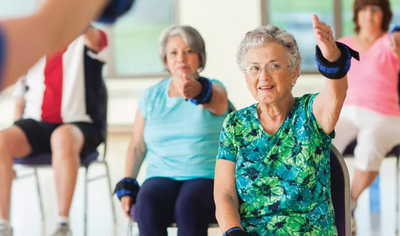
In fact, regular physical activity may also help with some non-movement symptoms such as mood and overall quality of life.
Exercise for seniors with Parkinson’s is not a cure for the disease, however, and the right program can vary considerably from one person to another. Symptoms, medications, fall history, and the stage of Parkinson’s can all affect which activities are appropriate.
Ultimately, Parkinson’s exercises for seniors should focus not simply on doing more exercise, but on choosing the right combination of the four categories of exercise which will be discussed in this article.
Why Exercise Matters for Seniors With Parkinson’s
Parkinson’s disease can affect much more than tremor; common movement symptoms include stiffness, slowness of movement, changes in posture, difficulty walking, and problems with balance.
Furthermore, when a person moves less, muscle strength and cardiovascular fitness can decline. Everyday tasks may then become more difficult. A well-designed Parkinson’s exercise for seniors program can help interrupt that cycle by keeping the body moving and challenging physical abilities that are important for independence.
The Parkinson’s Foundation considers exercise an important component of Parkinson’s management. Its current guidance emphasizes intentional exercise across four major areas: aerobic activity, strength training, stretching, and balance, agility, and multitasking.
What Benefits Can Exercise Provide?
Walking and Mobility
Aerobic activities such as walking and cycling can help maintain cardiovascular fitness and endurance. Exercise programs can also target gait (the way a person walks).
A 2025 study found that aerobic and resistance training improved measures of motor symptoms and walking speed. This supports the idea that one should include both aerobic activity and strength training for Parkinson’s rather than relying exclusively on one type of exercise.
Mood and Quality of Life
Exercise is not only about physical symptoms.
The Parkinson’s Foundation notes that physical activity can also have positive effects on mood. Just as importantly, remaining physically active makes it easier to continue participating in hobbies, family activities, travel, and other meaningful parts of life.
For many people, the most important goal of Parkinson’s exercise for seniors isn’t performing better in a gym; it’s continuing to live as independently and as actively as possible.
What Types of Exercises Are Best for Parkinson’s?
In 2026, the Parkinson’s Foundation and American College of Sports Medicine updated their exercise recommendations for people living with Parkinson’s. The framework emphasizes four areas:
1. Aerobic Exercise
Aerobic exercise raises the heart rate and challenges cardiovascular endurance. Depending on ability, options may include:
- Walking
- Stationary cycling
- Swimming or water exercise
- Dancing
For someone with significant balance difficulty, a stationary bicycle or another supported activity may be more appropriate than unsupported walking.
2. Strength Training
A complete program should challenge the major muscle groups rather than focusing only on the arms or legs. Examples of strength training for Parkinson’s might include appropriately modified sit-to-stands, resistance-band exercises, supported squats, rows, presses, or resistance machines.
Functional exercises can be particularly valuable because they relate directly to daily activities. Practicing an appropriately modified sit-to-stand, for example, strengthens muscles involved in getting out of a chair.
The Parkinson’s Foundation includes strength training as one of the four major exercise domains and recommends adapting the program as Parkinson’s progresses.
3. Balance, Agility, and Multitasking
Movement in everyday life rarely happens in a straight line on a perfectly flat surface. We turn, stop, step around objects, reach, change direction, and sometimes perform another task while moving. That is why balance exercises for Parkinson’s should include more than simply standing on one leg. Depending on the person's abilities, training may involve stepping patterns, directional changes, controlled weight shifts, agility, and gradually introduced multitasking.
Importantly, though, these exercises should always match the individual's fall risk. Challenging balance without appropriate support can increase rather than reduce danger.
4. Stretching and Mobility
Stretching helps address flexibility and comfortable movement. A routine may focus on areas that commonly become tight or stiff while also encouraging posture and trunk movement.
Furthermore, stretching and mobility work can compliment the previous three categories of exercises for seniors with Parkinson’s rather than replacing them.
Can Exercise Help With Falls and Freezing of Gait?
Exercise can help improve gait and balance, but falls and freezing deserve particular attention.
Freezing of gait can make a person feel temporarily unable to initiate or continue a step. Parkinson’s can also cause smaller steps, slower movement, and postural instability; these issues can significantly increase fall risk. The Parkinson’s Foundation recommends physical therapy for people experiencing walking difficulties, freezing, balance problems, falls, or concerns about exercise safety. A physical therapist with neurological expertise can assess why the difficulty is occurring and teach individualized strategies.
Overall, any balance exercise for Parkinson’s found online should not be treated as a substitute for an evaluation, especially when someone is already falling or experiencing significant freezing.
How Much Should Seniors with Parkinson’s Exercise?
The Parkinson’s Foundation has historically recommended working toward approximately 150 minutes of moderate-to-vigorous exercise per week, while its updated 2026 recommendations emphasize making exercise accessible, intentional, sustainable, and adaptable as the disease progresses. This does not mean that everyone should immediately begin exercising for 150 minutes per week. Someone who is sedentary may need to start with short periods of activity, while someone who already exercises regularly may be able to tolerate considerably more. An effective Parkinson’s exercise for seniors plan should therefore consider both recommended exercise targets and the individual's actual starting point.
Remember: consistency matters more than trying to accomplish everything during the first week.
Personal Trainer versus Physical Therapist: Which one Do I Need?
Both a personal trainer and a physical therapist have valuable roles, but they are not interchangeable.
A physical therapist is a licensed healthcare professional who can evaluate movement impairments and develop rehabilitation strategies. A qualified personal trainer or exercise professional has a different role; for an appropriate and medically stable client, a fitness professional can help implement a regular exercise routine, provide supervision and motivation, and work on general conditioning, mobility and strength training for Parkinson’s, and appropriate balance activities.
Ideally, these professionals complement rather than compete with one another; a physical therapist might establish specific movement strategies and safety recommendations, while a trainer helps the client remain active and consistently practice appropriate exercise over time.
How to Exercise Safely With Parkinson’s
Before starting or substantially changing an exercise program, discuss exercise with your healthcare team—particularly if there have been recent falls, fainting, cardiovascular concerns, major mobility changes, or other medical complications. Consider these principles:
- Exercise when movement is at its peak: Parkinson’s symptoms can change as medications take effect and wear off; your healthcare team can help determine whether medication timing should influence exercise timing
- Use appropriate support: A chair, countertop, railing, or professional supervision may be appropriate during balance exercises for Parkinson’s
- Avoid unnecessary fall risk: An exercise does not need to be unstable or complicated to be effective
- Progress gradually: Increase resistance, duration, or complexity only when the current exercise can be performed safely
- Pay attention to changes: New freezing, repeated falls, dizziness, pain, or a noticeable decline in mobility deserves professional attention
The Bottom Line
Exercise for seniors with Parkinson’s can be an important part of maintaining strength, mobility, balance, cardiovascular fitness, and everyday function. The most effective approach is usually not one specific exercise; it is a varied program combining aerobic activity, flexibility, strength training, and appropriately selected balance exercises.
Just as important, the program should evolve with the person. People experiencing freezing, frequent falls, significant balance changes, or new functional difficulties should consider working with a physical therapist who specializes in neurological conditions; appropriate ongoing exercise can then complement that clinical care.
At ElderFIT, we connect older adults with certified in-home personal trainers for seniors who focus on strength, balance, mobility, and maintaining independence. For someone who is medically appropriate for personal training, an ElderFIT trainer can help make regular exercise more accessible without requiring trips to a gym.
This article is for general educational purposes and is not a substitute for medical advice, diagnosis, physical therapy, or treatment. People living with Parkinson’s should discuss significant changes in symptoms, balance, walking, or exercise tolerance with their healthcare team.