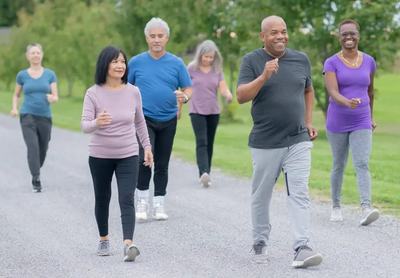
But did you know that a simple walk can become an even more effective fitness session with just a few small additions?
By incorporating a few strength, balance, and mobility exercises into your walk, you can improve muscle strength, increase endurance, and support your ability to stay independent as you age.
Before trying any new exercise, consult with your healthcare provider, especially if you have a medical condition, recent injury, or concerns about balance.
1. Add Short Bursts of Faster Walking
One of the easiest ways to increase the benefits of your walk is to vary your pace.
Try walking at your normal speed for several minutes, then increase your pace for 30–60 seconds before returning to your comfortable speed. Repeat this several times throughout your walk.
Benefits include:
- Improved cardiovascular fitness
- Increased calorie burn
- Better walking endurance
- Stronger leg muscles
The goal is not to sprint. Simply walk a little faster than your usual pace while maintaining good posture.
2. Use Light Hand Weights Carefully
Some seniors enjoy carrying very light dumbbells during a walk. Weights between 1 and 3 pounds can add a small upper-body challenge.
While walking, you can:
- Perform gentle bicep curls
- Alternate arm raises
- Maintain a stronger arm swing
However, heavier weights can place unnecessary stress on the shoulders, elbows, and wrists. If using hand weights causes discomfort, skip them and focus on purposeful arm movement instead.
3. Stop for Bench Push-Ups
Many parks and walking trails have sturdy benches that can be used for strength training.
Place your hands on the bench, step back, and perform a few incline push-ups. Because the bench elevates your body, the movement is much easier than a traditional floor push-up.
Start with:
- 5-10 repetitions
- 1-3 sets throughout your walk
This exercise helps strengthen the chest, shoulders, arms, and core.
4. Practice Sit-to-Stands
A park bench can also be used for one of the most important exercises for seniors: the sit-to-stand.
Simply sit down on the bench and stand back up without using your hands if possible.
Try:
- 5-15 repetitions
- One or two sets during your walk
This exercise strengthens the legs and hips while improving one of the most important daily functions: getting up from a chair safely and independently.
5. Incorporate Balance Challenges
Balance naturally declines with age, but regular practice can help reduce fall risk.
During your walk, find a safe location and try:
- Standing on one foot while holding a railing or bench
- Walking heel-to-toe along a sidewalk edge
- Briefly pausing and balancing before continuing
Always prioritize safety and hold onto a stable surface when needed.
6. Add Step-Ups
If you encounter a low curb, stair, or sturdy platform, consider adding a few step-ups.
Step up with one foot, bring the other foot up, then step back down.
Benefits include:
- Stronger legs
- Improved balance
- Better stair-climbing ability
Perform 5-10 repetitions per leg and use a handrail if available.
7. Focus on Good Posture
Walking is more beneficial when done with proper posture.
During your walk:
- Keep your head up
- Look ahead instead of down
- Relax your shoulders
- Engage your core muscles
- Swing your arms naturally
Good posture can improve balance, breathing, and walking efficiency.
8. Add Gentle Mobility Breaks
Every few minutes, stop and perform simple mobility exercises such as:
- Shoulder rolls
- Neck rotations
- Ankle circles
- Calf stretches
- Gentle torso twists
These movements can reduce stiffness and help maintain flexibility.
9. Walk Hills When Appropriate
If your neighborhood or local park includes gentle hills, consider adding them to your route.
Walking uphill can:
- Increase heart rate
- Strengthen the glutes and legs
- Improve endurance
Start with gradual inclines and avoid steep hills if balance or joint pain is a concern.
10. Turn Your Walk Into a Mini Circuit Workout
For an efficient full-body workout, alternate walking with simple exercises.
For example:
- Walk 5 minutes
- Perform 10 bench push-ups
- Walk 5 minutes
- Perform 10 sit-to-stands
- Walk 5 minutes
- Practice 30 seconds of balance exercises
This combination challenges the heart, muscles, and balance systems in a single session.
Walking Is a Great Start. A Little More Can Go a Long Way
A daily walk is already one of the healthiest habits a senior can develop. By adding a few simple strength, balance, and mobility exercises along the way, you can turn an ordinary walk into a well-rounded fitness routine.
The best approach is to start slowly, listen to your body, and choose activities that feel safe and enjoyable. Small improvements made consistently over time can lead to better strength, mobility, confidence, and independence.
At ElderFIT, we help older adults build personalized fitness routines that support healthy aging, whether that means walking farther, improving balance, building strength, or staying active at home.