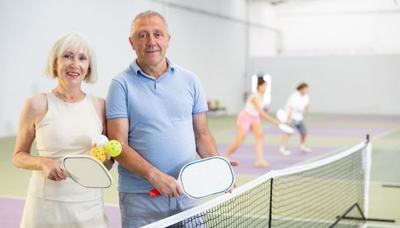
Pickleball can be a fun and social way to stay active while challenging coordination, balance, and agility.
But like any sport, pickleball comes with injury risks. Quick changes in direction, reaching for shots, and sudden stops can increase the chance of falls, sprains, strains, and fractures, especially for older adults who have balance or mobility limitations.
The good news is that many of these risks can be addressed with proper preparation. Building strength and balance, wearing appropriate footwear, warming up, and gradually increasing how much you play can all contribute to pickleball safety for seniors.
So, rather than asking whether pickleball for seniors is safe or unsafe, a better question would be: are you physically prepared for the demands of the game?
Is Pickleball Good Exercise for Seniors?
Pickleball for seniors has several advantages. The court is smaller than a tennis court, doubles play limits how much ground each player needs to cover, and the game combines walking with short bursts of faster movement.
The CDC identifies group sports such as pickleball as activities older adults may enjoy with others.
The social benefit shouldn't be overlooked; a regular game can provide a reason to leave the house, see friends, and stay involved in the community. For many older adults, enjoyment is what makes physical activity sustainable.
However, pickleball does not replace strength or balance training. The CDC recommends that older adults include both muscle-strengthening and balance activities as part of a well-rounded routine.
What Are the Most Common Pickleball Injuries in Seniors?
Research shows why pickleball injuries in seniors deserve attention. A national study published in 2025 found a substantial increase in pickleball-related emergency-department injuries between 2014 and 2023, with most injuries affecting people ages 60 to 79.
Another study examining U.S. emergency-department data found that most pickleball injuries occurred because of falls and that older players were disproportionately represented.
Research involving senior pickleball players found that slips, trips, falls, and dives accounted for a majority of injuries, while sprains, strains, and fractures were among the most common diagnoses.
These studies examine people injured badly enough to seek emergency care. However, they do not prove pickleball is unusually dangerous compared with other sports.
On the other hand, these studies are helpful in identifying which aspects of pickleball safety for seniors deserve particular attention.
Why Are Falls Such a Concern?
Falls are already a significant health issue for older adults. The CDC reports that more than one in four adults 65 and older falls each year and that falls are the leading cause of injury in this age group.
Pickleball adds movement challenges that aren't present during ordinary walking.
Players may need to:
- Move sideways quickly
- Stop suddenly
- Reach outside their normal base of support
- Pivot and change direction
- Move toward the net
- React while watching the ball instead of the ground
Those demands may help explain the prominence of falls among pickleball injuries in seniors.
Backpedaling can be particularly challenging because players cannot easily see where their feet are landing. Turning and moving toward the ball may be safer for some older players than rapidly taking several backward steps.
Who Should Be More Cautious About Playing?
Pickleball for seniors isn't automatically appropriate for every older adult.
Extra caution may be appropriate for someone with:
- A recent fall or repeated near-falls
- Significant balance difficulties
- Uncontrolled dizziness or fainting
- A recent fracture or surgery
- Severe joint pain
- Significant mobility limitations
- New chest pain or unusual shortness of breath with activity
- A long period of inactivity followed by a sudden return to sports
These issues don't necessarily mean someone must permanently give up pickleball. They may mean that medical guidance, physical therapy, conditioning, or modifications are appropriate before returning to play.
An older adult recovering from a significant injury should not use recreational pickleball as rehabilitation unless the appropriate healthcare or rehabilitation professional has cleared that progression.
How Can Seniors Play Pickleball More Safely?
The goal of pickleball safety for seniors isn't to remove every challenge from the game. It's to reduce unnecessary risks.
Warm Up Before Playing
The National Institute on Aging recommends warming up before exercise so the muscles are prepared and heart rate and breathing increase gradually.
Spend several minutes walking, marching, gently moving the shoulders, and practicing controlled court movements before starting competitive play.
Start Gradually
A new player doesn't need to play for two hours on the first day.
Start with shorter sessions and gradually increase playing time as conditioning improves. NIA similarly recommends increasing physical activity gradually, particularly for people who are returning after inactivity.
Wear Appropriate Footwear
Pickleball involves considerable side-to-side movement.
Shoes should fit securely, provide good traction, and support movement on the court surface. Court-specific footwear may be worth considering for people who play regularly.
Consider Doubles
Doubles can be a good introduction to pickleball for seniors because each player generally needs to cover less court than during singles.
It can also add one of pickleball's greatest advantages: social interaction.
Don't Play Through Warning Signs
Stop if you develop sharp pain, dizziness, chest discomfort, unusual shortness of breath, or sudden instability.
Fatigue matters too; as the legs tire, movement and balance can deteriorate. Pickleball safety for seniors therefore includes recognizing when it's time to take a break rather than playing one more game simply because everyone else is continuing.
Fatigue is also a legitimate reason to stop. Continuing to play when footwork and balance are deteriorating may increase the chance of injury.
How Can Strength and Balance Training Help?
Preparing for pickleball doesn't have to happen entirely on the court.
The CDC recommends that older adults perform muscle-strengthening activities at least two days per week and include activities that improve balance.
Those same abilities are directly relevant to pickleball:.
Useful off-court exercises may include:
- Sit-to-stands
- Calf raises
- Step-ups
- Controlled side stepping
- Hip and leg resistance exercises
- Core strengthening
- Shoulder mobility and strengthening
- Appropriately selected balance exercises
sStronger legs can make stopping, changing direction, and recovering from a low position easier;. bBetter balance can help a player maintain control when reaching or reacting unexpectedly.
That doesn't mean exercise will eliminate pickleball injuries in seniors. No strength or balance program can guarantee that someone won't fall.
But preparing the body for the physical demands of a sport makes more sense than expecting the sport itself to provide all the necessary conditioning.
For someone with substantial balance problems or a history of falls, challenging balance exercises should be performed with professional guidance.
How Do You Know If You're Ready for Pickleball?
A practical approach to pickleball safety for seniors is to consider what the sport asks your body to do.
Ask yourself:
- Can I walk briskly without unusual shortness of breath?
- Can I change direction without regularly losing my balance?
- Can I step sideways comfortably?
- Can I bend and reach without becoming unstable?
- Can I repeatedly stand from a chair?
- Can I tolerate moderate activity without excessive fatigue?
These aren't medical tests, and passing them doesn't guarantee safe play. They're simply practical questions that may highlight areas worth improving before taking up a faster-moving sport.
If several of these activities are difficult, some conditioning or professional guidance may make starting pickleball for seniors more comfortable and enjoyable.
The Bottom Line: Is Pickleball Safe for Seniors?
For many older adults, yes. Pickleball can provide enjoyable physical activity, coordination, social connection, and motivation to keep moving.
But safe participation depends less on someone's age alone than on their strength, balance, mobility, conditioning, joint and bone health, and how aggressively they play.
At ElderFIT, we connect older adults with certified in-home personal trainers for seniors who focus on strength, balance, mobility, and maintaining independence. For older adults interested in pickleball for seniors or other recreational activities, personalized exercise can help build the physical foundation needed to stay active and participate with greater confidence.
This article is for general educational purposes and is not a substitute for individualized medical advice. Older adults with significant health conditions, recent falls, surgery, or new symptoms should speak with an appropriate healthcare professional before beginning or returning to a demanding sport.